TL;DR - The Rhodesian Ridgeback is a southern African breed, recognizable by the stripe of reverse-grown hair on its back. Originally a versatile hunting dog, it is today a loyal family companion: calm at home, athletic outdoors, standing 63–69 cm at the shoulder for 32–36 kg. Expect €1,500–€2,500 for a registered puppy from a serious breeder. Best for active families and firm but kind owners who can channel its independent nature through positive, consistent training.
Sommaire
- Origins: the lion-hunter myth
- The dorsal ridge: breed signature
- Character and temperament
- How to train a Rhodesian Ridgeback
- Rhodesian Ridgeback puppy price
- Family suitability
- Health and lifespan
- Choose a serious breeder
- FAQ
Origins: the lion-hunter myth
The Rhodesian Ridgeback was born in southern Africa (today’s Zimbabwe, formerly Rhodesia) in the late 19th century. European settlers crossed their dogs (mastiffs, Great Danes, dalmatians) with the Khoikhoi tribe’s native ridgebacked dogs.
The result: a dog able to track over long distances in the savanna, withstand intense heat, and - its trademark - hold a lion at bay until the hunter arrived. Despite the legend, it does not kill the lion: it harasses and circles the cat, holding it in place without ever letting itself be caught.
This versatility - hunting, guarding, companionship - explains the breed’s complete temperament: enduring, brave, independent and affectionate with its family.
The breed was standardized in 1922 and is officially recognized by the FCI as the Rhodesian Ridgeback.
The dorsal ridge: breed signature
The famous ridge is a band of hair growing in the opposite direction to the rest of the coat, from behind the shoulders to the start of the tail. It is the breed’s mandatory hallmark.
The FCI standard requires:
- A clearly defined, symmetrical and tapering ridge
- It begins with two symmetrical crowns (whorls)
- It narrows progressively toward the hipbone
A puppy without a ridge (about 5–10 % of births) is still an authentic Rhodesian Ridgeback but cannot be used for breeding. These puppies make excellent companions and are sold at a reduced price.
Character and temperament
The breed’s character is often summed up as: “Lion outdoors, cat indoors”.
At home:
- Calm and discreet - happy to lounge close to its family
- Affectionate but reserved - does not jump on strangers
- Very clean, low odor, moderate shedding
- Rarely barks - prefers to observe and alert with body language
Outdoors:
- Athletic and enduring - needs at least 1.5 to 2 hours of activity per day
- Independent and curious - strong prey drive
- Watchful - natural guard dog without unprovoked aggression
This is a strong-willed dog: it has its own opinions, picks its moment to obey, and regularly tests boundaries. It is not made to be treated like a stuffed toy, but it is a deeply loyal companion for those who understand it.
How to train a Rhodesian Ridgeback
Three principles for successful Ridgeback training:
- Consistency - the same rules from every family member, every day
- Positive methods - it loathes brutality and shuts down under force. Reward, play, calm voice
- Early socialization - between 8 and 16 weeks, expose it to many people, dogs, and environments
Mistakes to avoid:
- Letting it dominate out of sentimentality: it will take charge and become unmanageable
- Relying on punishment: it withdraws and loses trust
- Underestimating exercise needs - a frustrated Ridgeback becomes destructive
Rhodesian Ridgeback puppy price
A registered (LOF/AKC/KC) Rhodesian Ridgeback puppy from a serious breeder ranges between €1,500 and €2,500 in Europe.
This price includes:
- Pedigree registration in the national kennel club
- Microchip identification
- Vet check and primary vaccinations
- Deworming
- Parental health screening: hip/elbow dysplasia, dermoid sinus, hypothyroidism
- Sales contract with health guarantees
Beware of listings under €1,200 - these usually hide unregistered breeding, no health testing, or problematic conditions. A Ridgeback is a 12–15-year commitment: breeder quality matters for the whole life.
Ownership cost: about €80–€120 per month (premium food, insurance, routine care).
Family suitability
Yes - provided exercise and structure are respected. The Rhodesian Ridgeback is generally excellent with the family’s children: patient, gentle, protective.
Suited to:
- Active families (running, cycling, hiking)
- House with fenced garden ideally - apartment possible but requires far more outings
- Regular presence at home - does not tolerate long solitude well
- A family member available and firm to ensure consistent education
Less suited to:
- Sedentary households
- First-time dog owners without professional support
- Households with small unsocialized pets (prey drive)
Health and lifespan
Generally robust, with a lifespan of 10 to 13 years.
Main conditions to monitor (and that serious breeders test for):
- Hip and elbow dysplasia
- Dermoid sinus (ridge-related anomaly, screened at birth)
- Hypothyroidism
- Gastric torsion (bloat) - like all large deep-chested dogs
A canine health insurance is strongly recommended from 8 weeks.
Choose a serious breeder
Signs of a serious breeder:
- Registered kennel name with the national kennel club
- Public, verifiable parental health tests
- Home-based or small-scale breeding (no factory farming)
- Open visit policy
- Post-sale follow-up - the breeder remains reachable
- Clear sales contract, hereditary defect guarantee
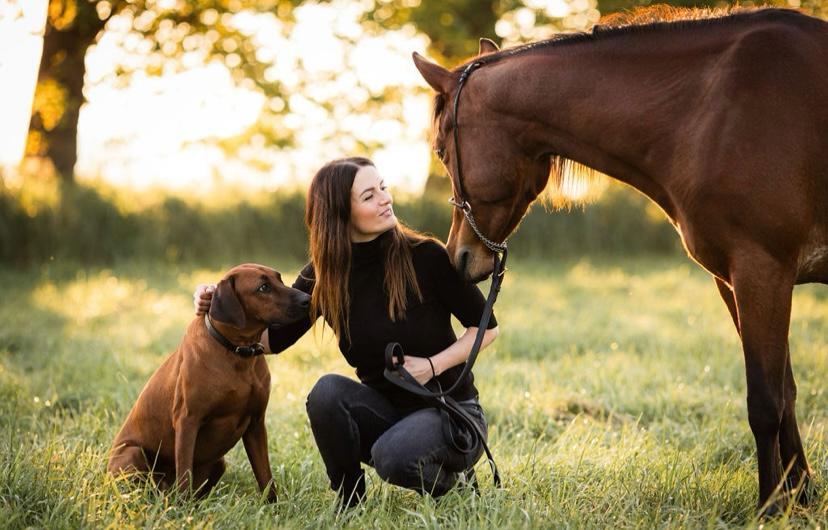
The Écurie de Livhest offers Rhodesian Ridgebacks bred in our family kennel in Brittany. All our puppies are registered, parentally health-tested, raised at home with other dogs and horses.
Discover our Rhodesian Ridgeback breeding - visits by appointment, contact us to meet the current litter.
Going further: who I am - Laetitia Collet’s philosophy as a breeder of both purebred Arabians and Rhodesian Ridgebacks.
FAQ
What is the price of a Rhodesian Ridgeback?
A registered Rhodesian Ridgeback puppy from a serious breeder costs €1,500–€2,500 in Europe (or $1,800–$3,000 in the US). Plan €80–€120 per month for ongoing costs.
Can a Rhodesian Ridgeback really kill a lion?
No, that is not its role. It was bred to corner the lion and hold the bay until the hunter arrived. Its task is to track, harass and hold the big cat at distance - never to fight it directly. It is a pack hunting dog, not a fighter.
How do you train a Rhodesian Ridgeback?
With positive, consistent and patient methods: reward, play, calm voice. Avoid harshness, which shuts it down. Start puppy class at 3 months, work on recall and socialization. Stay firm on rules: it will test boundaries.
Is the Rhodesian Ridgeback dangerous?
No. It is not classified as a dangerous breed in France. It is vigilant, naturally protective of its family, but without unprovoked aggression when properly socialized.
How much exercise does a Rhodesian Ridgeback need?
At least 1.5 to 2 hours of daily activity for an adult: long walks, running, cycling, play. An understimulated Ridgeback becomes anxious and destructive.
Is the Rhodesian Ridgeback good with children?
Yes, generally very patient and protective with family children. As with all large breeds, supervise interactions with young children and teach children to respect the dog (not disturbing while eating or sleeping).